Teemper Office
The Office as Declaration
There is a particular form of corporate intelligence that expresses itself in the design of the office: the conviction that the physical workspace can and should make visible the essential character of the organisation it houses. At its best, this conviction produces interiors of genuine inventiveness — spaces in which the values, the culture, and the creative ambition of the organisation are encoded in the architecture itself, so that to enter the office is to understand immediately who these people are and what they are about.
The Teemper Office, designed by Bricolage Bombay, belongs emphatically to this first category. Teemper is an Indian lifestyle and apparel brand whose identity is built around the concepts of individual expression, creative energy, and the productive tension between order and chaos. Its office is a precise spatial translation of these values — an environment in which the architecture itself argues for the creative life, and in which every design decision, from the articulation of the glass partitions to the choice of wall finish, is a statement of organisational identity.
Typography as Architecture
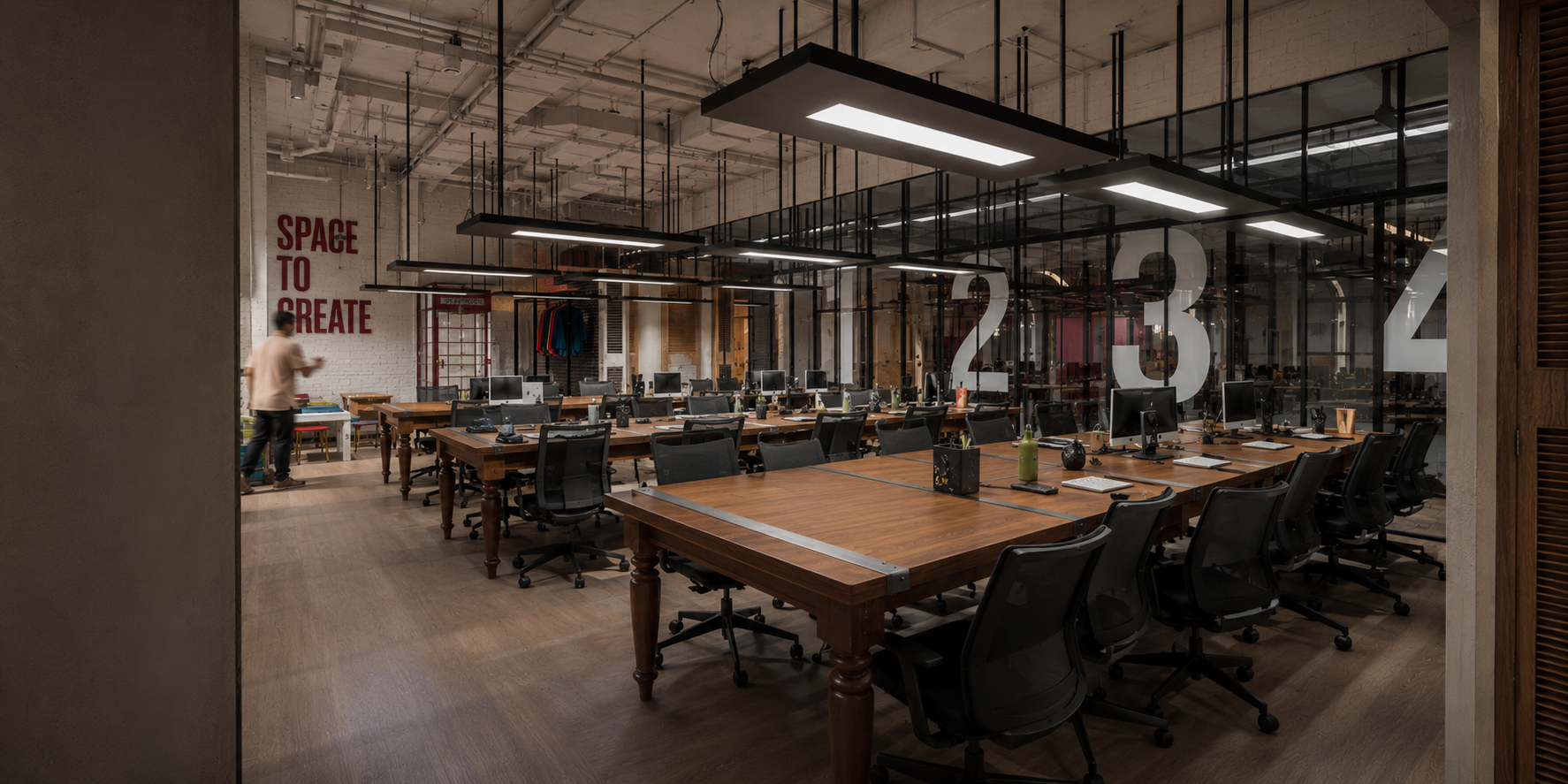
The most immediately striking element of the Teemper Office interior is the treatment of the glass partition wall that separates the open workspace from the cellular offices beyond. This wall is printed with large-format typographic characters — the numbers 1, 2, 3, 4 identifying each office bay — in a scale and weight that transforms them from informational signage into architectural elements. The characters are rendered in a bold sans-serif typeface, their scale precisely calibrated against the height of the partition so that each number occupies the full vertical extent of the glazing, reading simultaneously as room identifier and as abstract graphic composition.
This typographic strategy is reinforced by the “SPACE TO CREATE” installation on the opposite wall of the primary workspace — a large-format text piece that functions as an internal manifesto, a daily reminder to everyone who works in this environment of the nature and purpose of their activity. The integration of typography at this scale into a workplace interior moves beyond conventional corporate values signage and into the territory of environmental graphics — a discipline in which the boundary between interior design and brand communication is productively dissolved.
The Open Plan and Its Creative Logic
The primary workspace of the Teemper Office is organised as a long-table open plan — rows of continuous desks running the full depth of the space, each workstation defined by its own monitor and keyboard rather than by any physical partition. This format is chosen not for its operational efficiency alone but for its social implications: the long table is a democratic form, one that places all participants in a direct visual and spatial relationship with one another, creating the conditions for the spontaneous collaboration and cross-pollination of ideas that defines a creative organisation at its best.
The exposed services ceiling — structural elements, HVAC ducts, and conduit left visible above the workstations — introduces the industrial aesthetic vocabulary that has become the dominant idiom of creative workspace design globally. The decision to leave these elements exposed rather than concealing them behind a suspended ceiling is, in part, practical. But it is also, in part, philosophical: the exposed ceiling reads as honest, as anti-corporate, as consistent with the values of an organisation that prizes transparency and authenticity.
The white-painted exposed brick wall that defines the primary workspace provides the thermal and visual mass against which the other, lighter elements of the interior can be read with maximum clarity. The red vertical curtain element visible in the renders introduces the single most vivid note of colour in the scheme — a vertical punctuation mark that draws the eye and activates the spatial composition. Bricolage Bombay’s Teemper Office is a demonstration of the practice’s capacity for commercial interior design at the level of brand intelligence — a space that does not decorate a workplace but fundamentally rethinks what a workplace can be when an organisation’s values are taken seriously enough to be made spatial.