DIORO 1504
A Small Room, Held to the Light
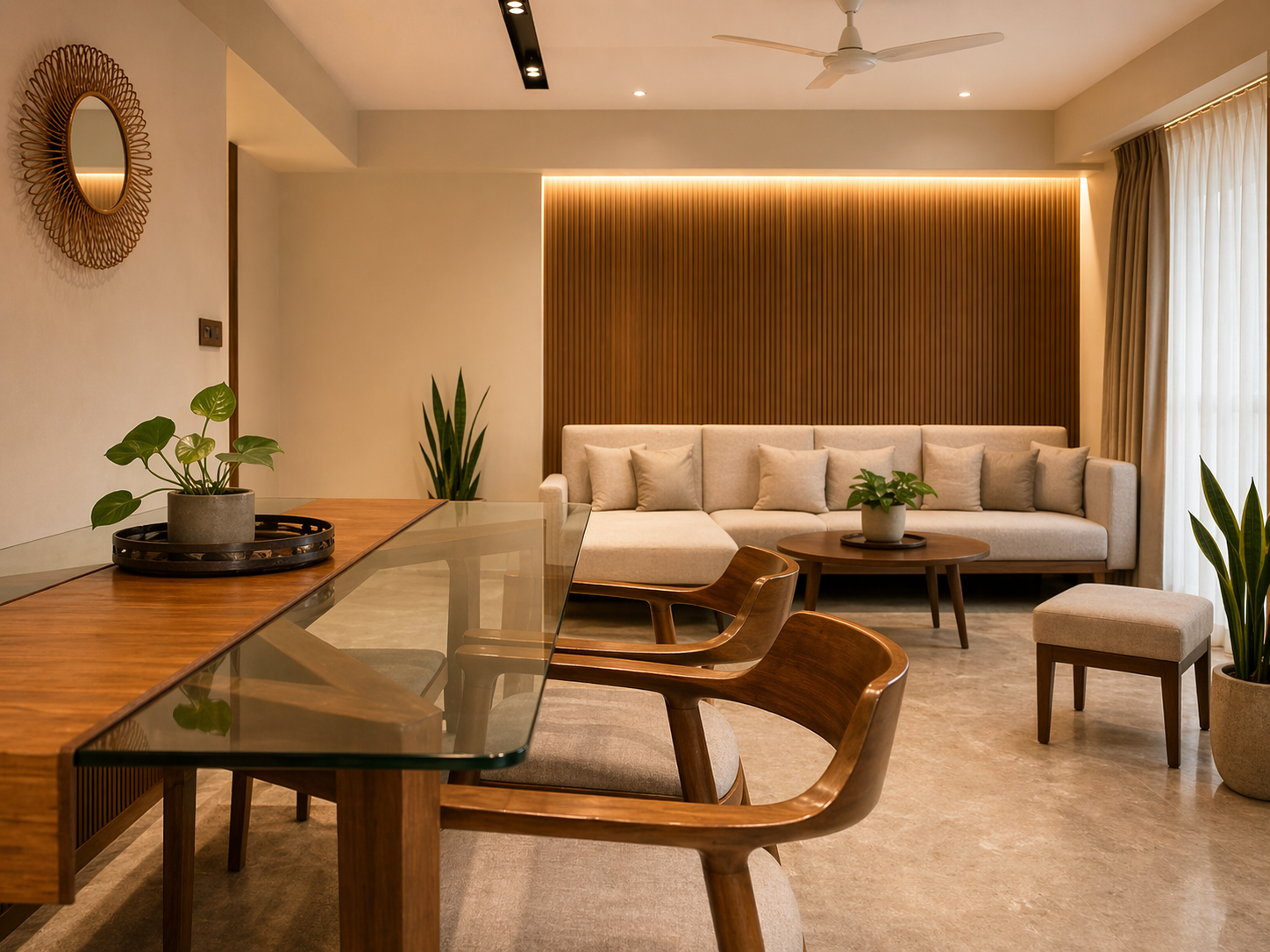
The first thing the flat does is breathe out. You step in from the corridor—that familiar Mumbai sequence of lift lobby, neighbour’s door, the muffled press of a tower full of lives stacked one above another—and the room ahead simply opens. A long stone floor runs away toward a wall of glass, the late light pooling on it like water; a low sofa waits under a band of warm timber; a glass-topped table catches the lamps overhead. There is no foyer to speak of, no grand gesture, and yet the eye is given somewhere to go. For a home of barely nine hundred square feet, that sense of distance is the whole trick, and it has been engineered with great care. This is flat 1504 at Dioro, a residence in Mumbai designed by Bricolage for Shirish Handa. By the arithmetic of the city it is a modest apartment—the kind of carpet area a family negotiates around rather than luxuriates in. But the studio has refused to treat the constraint as a deficit. Instead, the smallness has been met head-on, made the brief’s central question rather than its apology: how do you make a compact flat
feel not merely efficient, but generous? How do you give a working family room to breathe in a plan that, on paper, offers very little of it?
The answer here is not spatial sleight of hand so much as material conviction. Where a lesser scheme might have chased the illusion of size with white walls and mirrored tricks, Bricolage has done almost the opposite. It has filled the flat with warmth—with stone and timber and linen and the low gold of concealed light—and trusted that a room which feels good to be inside will also feel larger than it is. It is a wager on atmosphere over arithmetic, and it pays off.
One Long Volume, Read in a Single Breath
The organising move is deceptively simple. Rather than carve the public floor into the usual cluster of small, defensible rooms—a living room here, a dining room there, a kitchen sealed off behind a door—the studio has let the main space run as one continuous volume, drawing living and dining into a single uninterrupted length. You read the whole of it in one breath, from the sofa at one end to the daylight at the other, and the room borrows depth from its own honesty. Holding that length together is a frame of black steel and glass—a Crittall-style partition with slender mullions that screens the kitchen and balcony zone from the living and dining without ever truly closing them off. It is the most quietly intelligent decision in the flat. A solid wall there would have amputated the room, lopping off its far reach and its light. Instead the steel grid lets the eye travel clean through to the glazing beyond, so the balcony’s daylight is shared back into the heart of the home. The partition does the work of a wall—defining the kitchen, giving it a threshold, lending the cook a sense of room—while behaving like a window. You are always aware of the space on the other side; the flat never feels as though it ends at arm’s length. That single device sets up the logic of everything else. Because the volume is continuous, the furniture has to do the dividing, and it does so with a light touch. Zones are suggested rather than enforced—a sofa marks the living end, a table the middle, the steel screen the kitchen—so the eye is never stopped, only gently directed. It is the difference between a flat that feels parcelled out and one that feels whole.
The Banquette, and the Art of Sitting Against a Wall
Look closely at how the seating is arranged and you find the plan’s real cleverness. Along one full wall runs a built-in upholstered bench—a low banquette in pale linen that doubles as sofa, dining seat, and reading perch depending on where you are sitting at any given hour. By pinning the soft seating to the wall, the studio reclaims the centre of the room. The dining table can sit close to the banquette and be served from it, café-style, with chairs only on the outer side; the floor stays open; circulation flows around the furniture rather than fighting through it. It is a move borrowed, knowingly, from the way small European apartments and good restaurants have always solved the problem of too little space—put the bench against the wall and let the table come to it. Here it means a family of several can sit down to eat in a flat that, by any rational measure, has no separate dining room at all. The glass top of the table keeps the gesture light; you see straight through it to the floor, so the table reads as a plane of reflection rather than a block of mass. The chairs around it are solid timber, mid-century in spirit, with curved backs and softly upholstered seats—pieces chosen to be touched, with the warm patina of wood that improves rather than ages.
The same principle governs the living end, where a low sectional in the same family of pale, sand-coloured fabric wraps a corner, generously cushioned, facing a wall-mounted screen and slim console. Nothing is oversized. Every piece has been scaled to the room rather than imported from a showroom floor where rooms are larger and ceilings higher. This is furniture that knows exactly how much space it is allowed to take, and takes not an inch more.
A Wall of Timber, Lit from Within
If the flat has a hearth—a centre of gravity that the eye returns to—it is the timber wall behind the sofa. A band of warm wood, run in fine vertical flutes, rises behind the seating and is washed from above and below by concealed light, so that the grain glows rather than merely sits there. In a room of pale stone and paler upholstery, it is the single sustained note of colour and depth, and it does an enormous amount of quiet work. It gives the sofa a back, a sense of being held; it warms the whole room by reflection; and it turns a blank structural wall into something closer to a piece of joinery. Fluting recurs throughout the flat as a kind of signature—a fine vertical rhythm pressed into timber and stone alike, catching the light in soft parallel lines. It appears again behind the dining banquette, where a panel of ribbed wood is set into a niche and lit from within, framing the seat like an alcove. It returns in the kitchen, on the tall units. It is a restrained ornament, the only one the flat really permits itself, and it earns its keep by being tactile rather than loud—something you register first with the eye and want, immediately, to confirm with a hand. Light here is almost always indirect. The flat is laced with concealed coves and slim track fittings rather than bright overhead glare; the timber walls are backlit, the niches glow, the under-cabinet strips in the kitchen lay a soft wash across the stone. Over the table and through the living end hang cage pendants in black metal—industrial in their geometry but warm in their bulb—casting filigree shadows across the ceiling at night. The effect, after dark, is of a room lit the way a good restaurant is lit: in pools and layers, never floodlit, so that every surface keeps a little of its mystery and the modest dimensions soften into something atmospheric.
Material Interiority: Stone, Linen, Cane, Brass
The flat’s palette is tight and deliberate, and it is worth naming, because the whole argument of the home is made in its materials. Underfoot, a warm, large-format stone in shades of cream and pale gold runs almost seamlessly through the public rooms—honed rather than polished, so it reads soft and matte and holds the light without flashing it back. Against it, the timber joinery glows amber; the upholstery sits in a narrow band of oatmeal, sand and undyed linen; and small accents of brass and aged metal—a floor lamp, a faucet, the cage of a pendant—give the whole composition a faint, antique warmth. Texture does the work that colour might elsewhere. There is the woven cane of a sunburst mirror, its spokes radiating across the wall like a quiet sun—a motif the studio clearly loves, and one that reappears as a soft, handmade counterpoint to all the straight lines. There is the slub of the linen, the grain of the wood, the matte cool of the stone, the patterned wool of a kilim rug laid under the dining table to anchor it. Each material has been chosen for how it feels as much as how it looks, and the restricted range—four or five materials, no more, repeated with discipline—is precisely what makes the small flat feel calm rather than busy. A larger palette would have fractured the space; this one binds it. Greenery threads through everything. Snake plants stand sentinel in stone pots; a money plant trails from a console; small bonsai and potted ficus sit on the table and the kitchen island, bringing a living, changing note into a scheme that is otherwise all warm neutrals. They are not decoration so much as punctuation—the green that makes the beige read as warmth rather than blandness, the life that keeps the restraint from tipping into severity.
The Kitchen, Brought into the Light
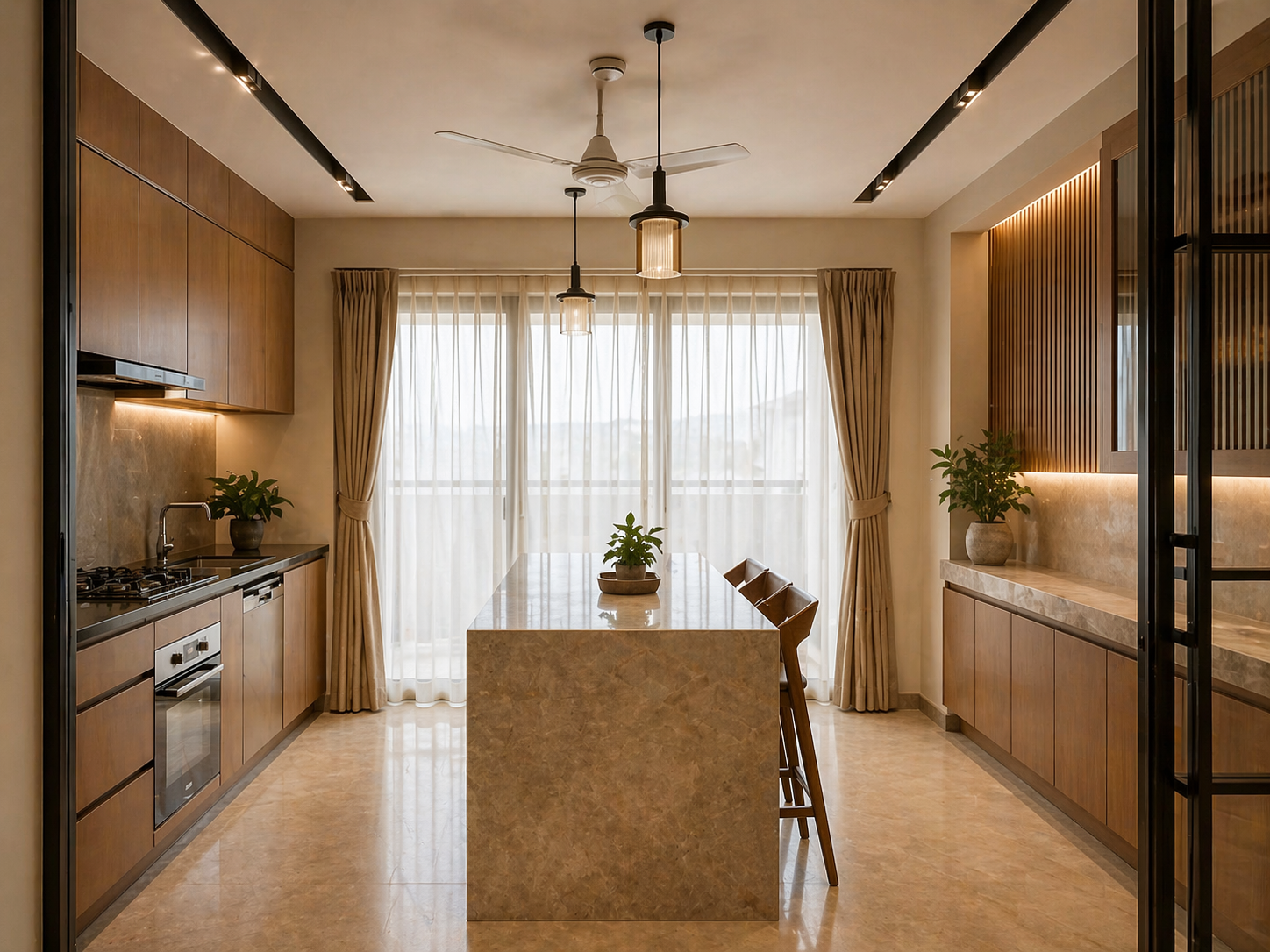
Through the steel-and-glass screen lies the kitchen, and it is treated not as a service zone to be hidden but as a room worth looking into. Wood-veneer cabinetry in the same warm tone as the living-room joinery lines the walls, its tall units fluted to match the language of the rest of the flat, its surfaces lit from beneath so the counters glow. At the centre stands a stone island—its top and sides cut from a richly veined, golden-cream stone and carried down in a single waterfall fall to the floor—doubling as preparation surface and casual perch, with a pair of slender timber stools drawn up to it. Behind it, full-height glazing dressed in floor-length sheers opens the kitchen to a balcony and to the sky beyond, flooding the whole working end of the flat with soft, filtered daylight. It is a generous, almost luxurious amount of light to grant a kitchen of this size, and it transforms the room. Integrated appliances—oven, hob, slim hood—keep the surfaces clean and the visual noise low. Because the steel partition lets the cook see straight through to the dining table and the living room beyond, the kitchen never feels banished; whoever is cooking remains part of the life of the house, in conversation with the room rather than shut away from it. In a compact flat, that sociability is not a small thing. It is, in many ways, the point.
A Chair to Read In, a Wall of Books
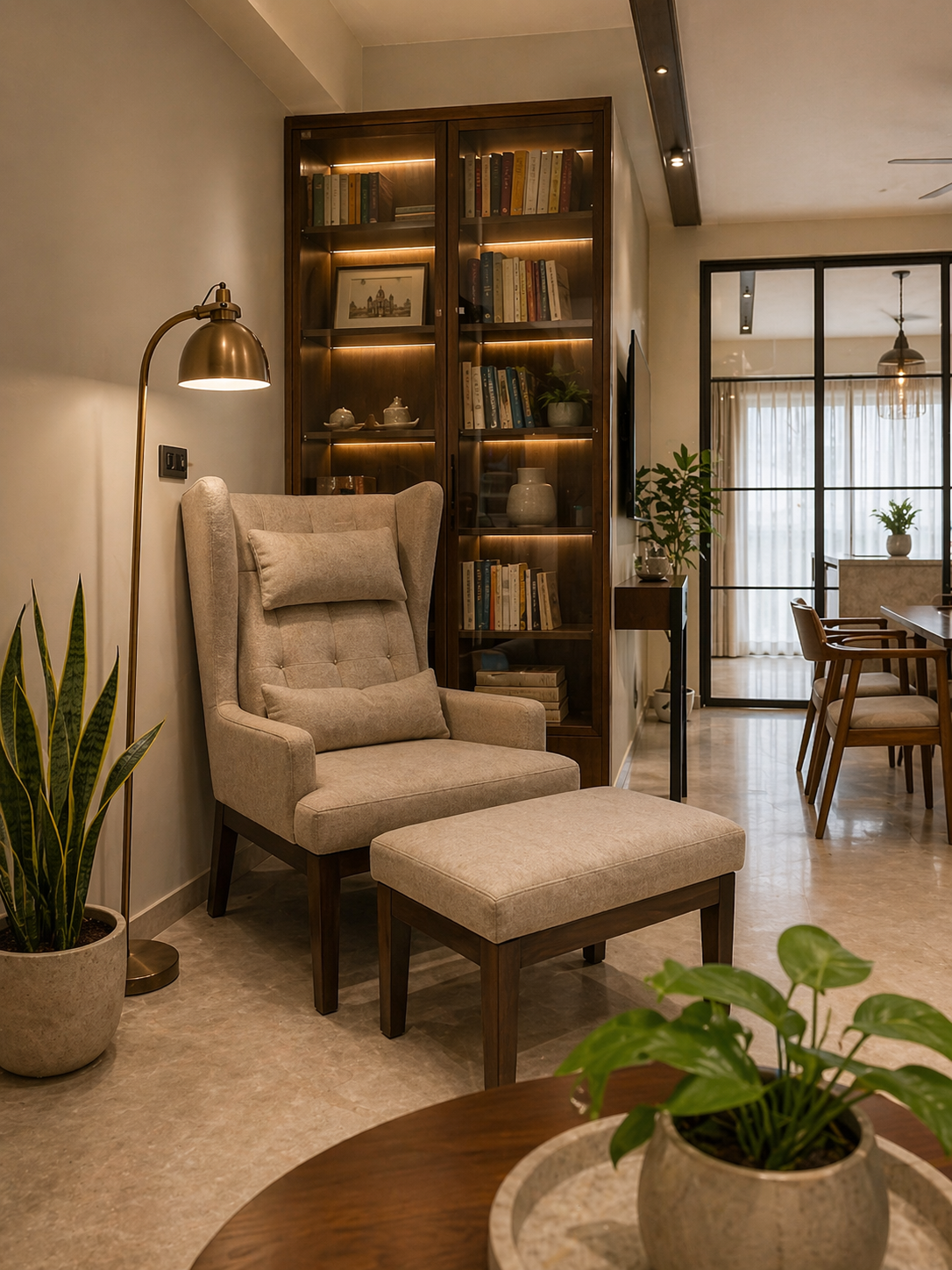
Every good home needs a corner that belongs to no one in particular and so belongs to everyone, and here it is a reading nook tucked against a tall, glass-fronted timber bookcase. The case is lit from within, its shelves carrying books, ceramics and a few framed pictures behind glass—part library, part cabinet of small treasures—so that the spines and objects glow softly against the dark wood. Before it sits a wing-backed lounge chair in pale linen with a matching ottoman, an antique-brass floor lamp arched over one shoulder for light to read by, a snake plant standing guard. It is the most personal moment in the flat, and the most telling. In a home where space is precious, the studio has spent some of it on the apparently unproductive luxury of a single good chair and a wall to keep one’s books—a small declaration that this is a place for slow hours as well as busy ones. The nook sits just off the main volume, within sight of the steel screen and the dining table beyond, so that even when you retreat into it you are not cut off; you read with one year still on the life of the house. It is privacy without isolation, which is exactly the kind of privacy a small flat can actually afford.
Bathing in Stone
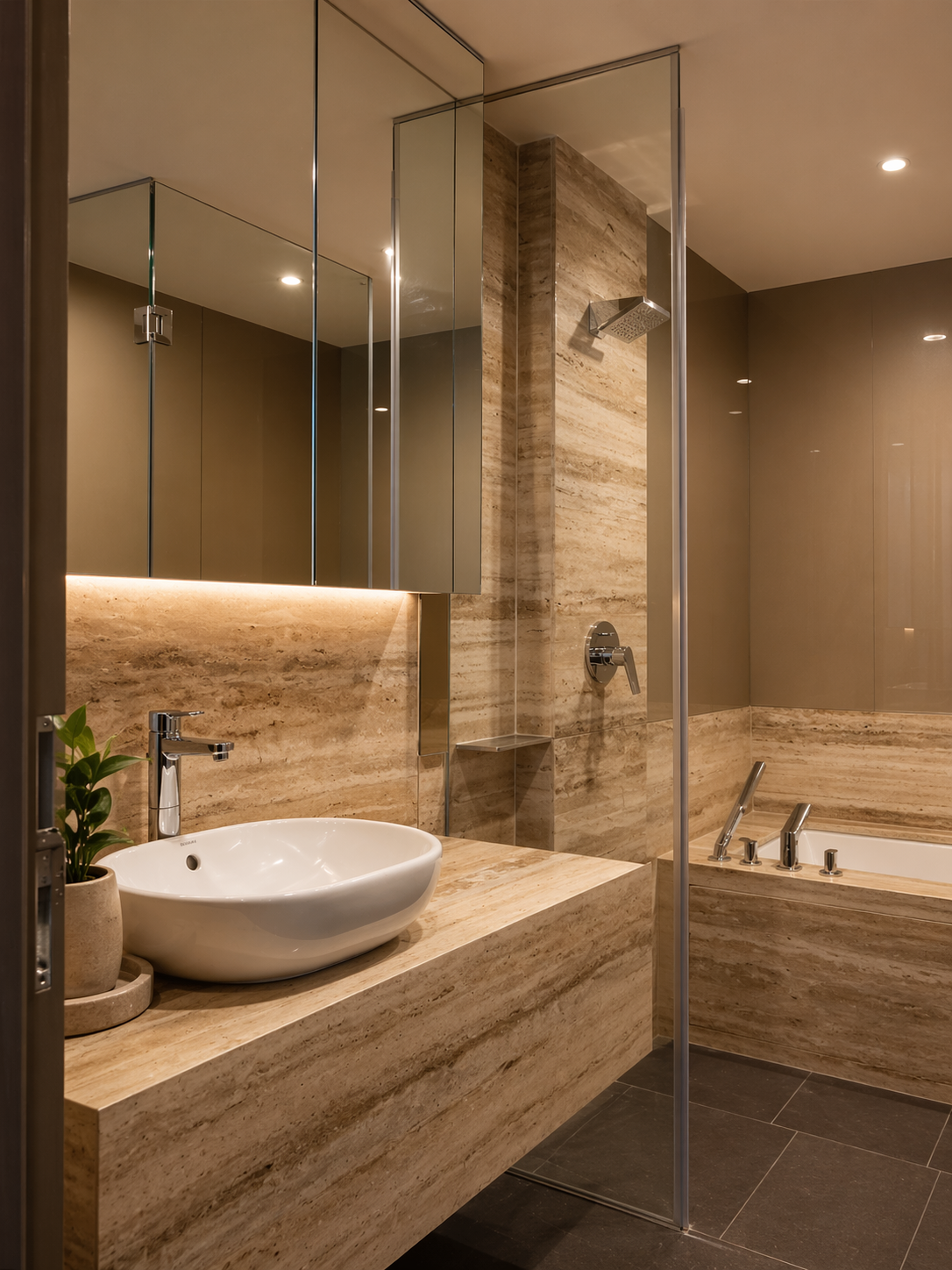
The bathrooms are where the material argument reaches its most concentrated pitch. Here the studio has clad walls, vanity and surrounds in travertine—that honeyed, horizontally banded stone whose grain runs in soft strata like the layers of a riverbank. A vessel basin sits on a floating travertine slab; a mirror, lit warm from behind, floats above it; a glazed walk-in shower with a rain head stands alongside a built-in tub, the whole composition reading as a single, quiet cave of stone. The effect is unexpectedly serene, almost spa-like, the banded travertine bringing a sense of geological calm into what is, in plan, a very small wet room. A second vanity carries the same logic—travertine surfaces, an oval vessel basin, slender chrome taps, and a tall slot of window that admits a blade of daylight and a glimpse of green. Throughout, the bathrooms refuse the hard glare of the typical apartment bathroom; the lighting is warm and concealed, the stone is matte, the fittings are simple and unfussy. They feel less like utilities than like the most private rooms of a considered home—which, of course, is what they are.
The Case for Restraint
What is most striking about flat 1504, in the end, is what it does not do. It does not chase a style or a statement. There is no signature colour, no feature gimmick, no attempt to disguise the flat as something grander than it is. The studio has resisted every temptation to over-fill or over-design a small space—the temptation, especially acute in a compact home, to compensate for size with busyness. Instead it has done the harder, quieter thing: chosen a few good materials, repeated them with discipline, lit them softly, and stopped. That restraint is not the same as emptiness. The flat is full—of warmth, of texture, of small considered moments—but it is never crowded, and the difference is everything. Each decision has been made to serve the feeling of the room rather than to announce the designer’s presence. The architecture recedes so that the life inside it can come forward; the home is built for its inhabitants rather than for the photograph, even as it photographs beautifully. In a market that often equates good design with visible expense, this is a gently radical position: that the measure of a home is not how much it shows, but how it feels to live inside. And it feels, against all the odds of its plan, expansive. Nine hundred square feet have been made to behave like far more, not by trickery but by warmth—by a long room held to the light, a wall of glowing timber, a single chair for reading, and a palette of stone and linen that asks to be touched. Bricolage set out to give a family room to breathe in a flat that offered very little, and somewhere in the working of stone and steel and soft light, the studio found it. The smallness never disappears; it is simply, quietly, no longer the point. What remains is the rare and difficult achievement of a home that is exactly the right size, and feels, somehow, like all the room in the world.
Location : Mumbai
Client: Shirish Handa
Area : Approx. 900 sq ft
Typology: Luxury Interior
Status: Completed