
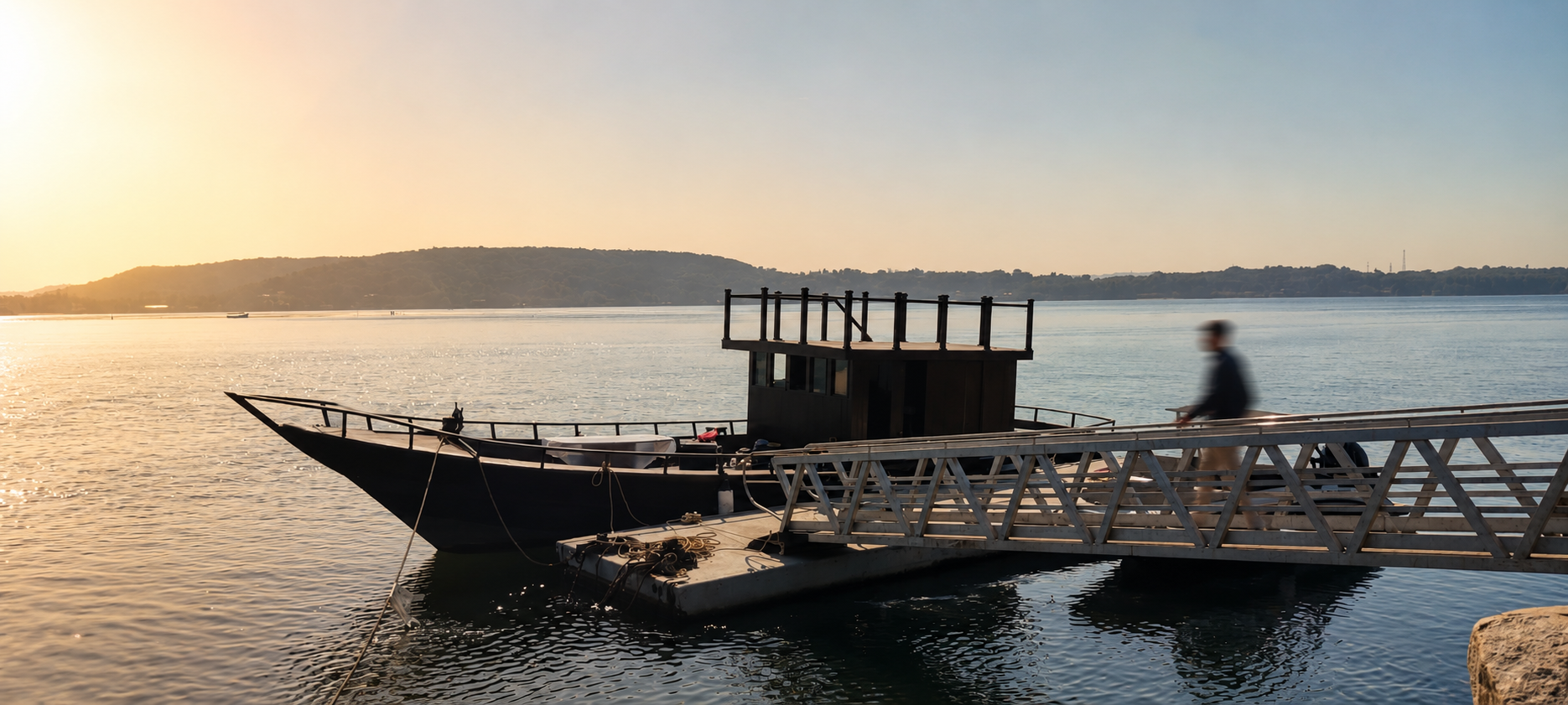
Sir Tuffy: Reimagining the River Boat as a Dining Experience
Floating restaurant design sits at the intersection of two disciplines that rarely meet: naval architecture and hospitality design. A dining boat has to satisfy the unforgiving logic of a vessel — weight, balance, stability, safety — while delivering the comfort, atmosphere and theatre of a fine restaurant. With Sir Tuffy, the Riviera river boat, we set out to reimagine what a meal on the water could be.
This article explores the unique challenges and pleasures of designing a restaurant that moves.
A restaurant that moves changes everything
The single fact that a floating restaurant moves transforms every design decision. The view is never static — it unfolds as the boat travels, so the experience is cinematic rather than fixed. Guests are not looking at a single scene; they are moving through a sequence of them. The design has to make the most of this motion, orienting seating and sightlines so the changing shoreline becomes part of the meal.
This is the great gift of a dining boat: it offers something no land-based restaurant ever can — a view that is alive and continuously renewing itself.
The constraints of the vessel
Designing on water means designing within hard limits. Weight distribution affects stability. Every kilogram and its placement matters. Space is tight, services are constrained, and safety regulations are non-negotiable. These constraints are not obstacles to good design — they are its discipline. The most elegant solutions on a boat come precisely from working within these limits rather than against them.
We approach the vessel like a puzzle in which comfort, atmosphere and operational practicality all have to be solved simultaneously within a fixed envelope. The result is a space where nothing is arbitrary.
Intimacy on the water
A boat is, by nature, an intimate environment. There is nowhere to escape to, which makes the atmosphere onboard all the more important. We design floating restaurants to feel like a single shared journey — a sense of being collectively transported — while still carving out moments of privacy at the table. The intimacy of the vessel becomes part of the romance of the experience.
Lighting, acoustics and seating all work to make a small, moving space feel generous and special rather than cramped.
Designing for the changing light of the river
On the water, light is everything and it never stops changing. The same boat at golden hour, at dusk and after dark is three different experiences. We design the lighting of a floating restaurant to choreograph this journey through the evening, so the mood onboard evolves in step with the sky and the water outside.
This is where a dining boat becomes truly magical — when the designed light inside and the natural light outside move together across the length of a voyage.
Theatre and arrival
Boarding a dining boat is inherently theatrical. The act of stepping aboard, casting off and leaving the shore behind is a built-in piece of drama that a land restaurant can only dream of. We design to amplify this theatre — the threshold of boarding, the moment of departure, the slow reveal of the route — so that the experience has a clear narrative arc from embarkation to return.
Why floating restaurants capture the imagination
A meal on a boat lodges in the memory in a way an ordinary dinner rarely does, because it combines food with journey, intimacy with spectacle. Sir Tuffy reimagines the river boat as exactly this kind of memory-making machine — a restaurant whose greatest ingredient is the water it moves across.
The galley: designing a kitchen that floats
The hardest problem on a dining boat is the kitchen. A galley has to produce restaurant-quality food within a fraction of the space, power and ventilation of a land kitchen, all while the floor moves. Solving the galley is the true test of floating restaurant design: every appliance, every metre of counter and every storage decision has to be optimised. When the kitchen works, the rest of the experience is free to feel effortless.
Acoustics and comfort on the water
A boat is a hard-edged, enclosed environment, and without careful acoustic design a dining boat can become uncomfortably loud as soon as it fills. Sound-absorbing materials, considered layouts and attention to engine and water noise all shape whether guests feel they are at a refined dinner or trapped in an echo chamber. Comfort on the water — acoustic, thermal and physical — is what allows the romance of the journey to come through.
The voyage as the menu’s setting
On a dining boat, the food and the journey are inseparable — each course arrives against a different stretch of shoreline, a different quality of light. The most thoughtful floating restaurants choreograph the meal and the voyage together, so that the rhythm of the route and the rhythm of the menu reinforce one another. The result is a kind of dining theatre that no fixed venue can replicate.
Designing for this means thinking about timing as carefully as space: where the boat will be at sunset, when the most dramatic views arrive, how the pace of service maps onto the pace of the journey. When it works, guests remember not just what they ate but where they were when they ate it — the bend in the river, the lights coming on along the bank, the moment the city slipped into dusk. That fusion of place, time and taste is the unique promise of a restaurant that moves.
Bricolage Bombay designs experiential and hospitality spaces that turn a venue into a journey. Explore our work or speak with us about your concept.




Leave a Reply