
Scenography & Themed Environment Design: The Stagecraft Behind a Mumbai Museum
On borrowing the craft of the stage — and why every memorable museum in Mumbai is, secretly, a piece of scenography.
The theatre learned long before architecture did that a space can pretend, persuade and transport. Scenography — the art of designing the stage so that it tells the story before a word is spoken — is one of the oldest spatial disciplines, and it sits quietly inside much of our museum and experiential work at Bricolage Bombay. A themed environment is not just a decorated interior; it is a set, built to carry a narrative and to make a visitor in Mumbai feel they have stepped into another time, place or idea. To design these spaces is to think like a set designer as much as an architect.
Every museum that has ever moved you was, in part, a stage — and you were the actor who walked on.
The set that tells the story
What can a room say about a world before anyone explains it?
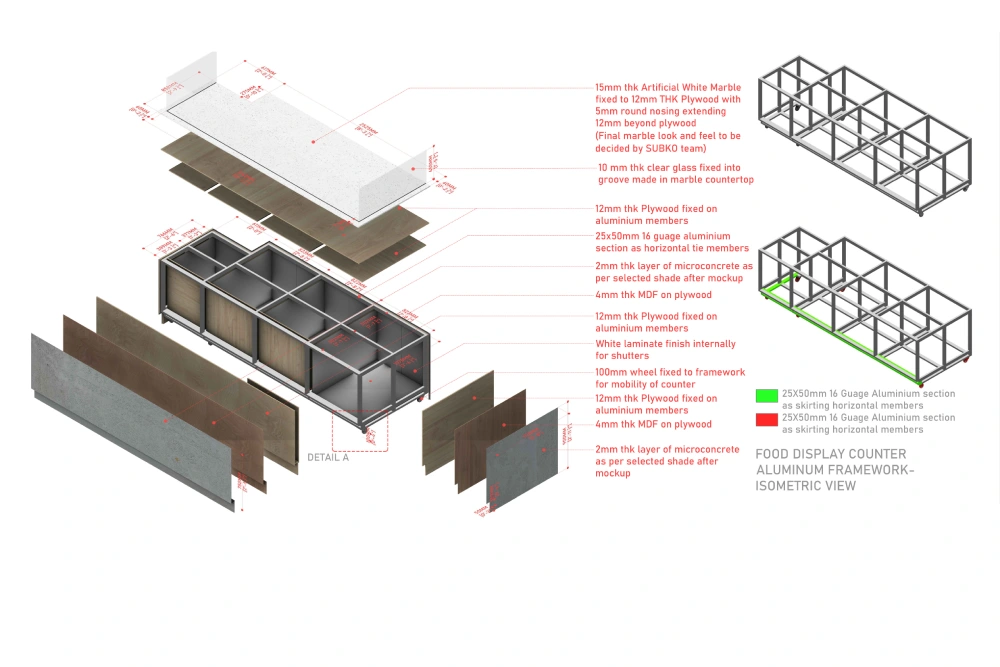
A great set does its storytelling instantly and silently. The moment the lights come up, the audience knows where they are, when they are, and how to feel. A themed museum environment works the same way: a visitor crossing into it should grasp the world without a label, through material, colour, scale and light alone. When we designed Subko @ MuSo — a cafe set within a museum — the space had to read as a continuation of the institution’s story rather than an interruption of it. Scenography is what lets an environment speak before the signage does.
Authenticity over imitation
How do you evoke a world without descending into pastiche?
The danger of themed design is kitsch — the cardboard version of a place that fools no one. We chase the opposite: evocation rather than imitation, capturing the spirit of a world through honest material and restrained gesture rather than literal copying. A themed environment that respects its audience trusts suggestion over spectacle, the well-chosen detail over the laboured replica. This is the difference between a set that transports and a backdrop that embarrasses, and it is a line we walk with care in every museum and hospitality project across Mumbai.
Theming, done well, is not just decoration; it is atmosphere with discipline.
Designing the unseen machinery
What does the stage hide so the magic can happen?
Behind every convincing set is a world of machinery the audience never sees — the rigging, the wings, the quick-change. Themed museum environments demand the same hidden craft: services, storage, structure and maintenance concealed so completely that the illusion holds even as the space is cleaned and reset around the clock. We design the backstage with as much rigour as the stage, because in an experiential space the seam, once seen, can never be unseen. The magic depends on the invisibility of the labour.
Atmosphere as the real exhibit
Why do we remember how a space felt long after we forget what it contained?
Scenography understands that atmosphere is not a finishing touch but the main event. Long after a visitor forgets the objects in a museum, they remember its mood — the hush, the warmth, the charge in the air. We design that atmosphere deliberately, treating it as the most durable thing we make. This is as true of a children’s museum’s exuberance as of a spiritual gallery’s stillness; the theme is simply the key the atmosphere is played in.
The curtain and the city
When a visitor steps out of a themed environment and back into Mumbai, the contrast itself completes the experience — the way leaving a theatre at night makes the ordinary street feel briefly unreal. That is scenography’s final trick: to send people back into their own city seeing it, for a moment, as a stage they too are walking across.
A museum, in the end, is a theatre that never lowers its curtain — and every visitor is welcome on the stage.
Bricolage Bombay is a Mumbai-based architecture and experiential design studio designing scenographic and themed environments for museums, hospitality and cultural spaces across India. Explore our work or speak with us about your environment.






Leave a Reply