

Designing for Play: How Interactive Museum Exhibits Engage Children
Interactive museum exhibit design is one of the most demanding disciplines in spatial design because it answers to an unforgiving client: a child who will simply walk away the moment they are bored. An exhibit cannot lecture. It has to provoke, reward and surprise — and it has to do so in seconds. At MuSo, the Museum of Solutions in Mumbai, the Play Lab was our laboratory for exactly this problem.
This article unpacks how interactive exhibits actually engage children, and the design principles that separate an exhibit children love from one they ignore.
Play is serious cognitive work
The word “play” can make educators nervous, as though it were the opposite of learning. In reality, play is how children run experiments on the world. When a child stacks, balances, climbs or knocks something down, they are testing hypotheses about gravity, structure and cause and effect. Good interactive exhibit design takes this seriously and engineers the environment so that every action produces a legible, immediate reaction.
That feedback loop — do something, see a result, adjust — is the engine of engagement. Design it well and a child will repeat an action a hundred times, each repetition a tiny experiment.
Designing for the body, not just the eye
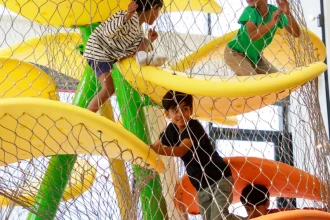
Adults experience museums largely through their eyes. Children experience them through their whole bodies. An interactive exhibit for children therefore has to be designed kinaesthetically — around climbing, reaching, pushing, crawling and balancing. The Play Lab uses the body itself as the instrument of learning, so that physics and spatial reasoning are felt before they are ever explained.
This has real architectural consequences. Heights, handholds, fall zones, surface textures and the geometry of movement all become primary design decisions rather than afterthoughts. The exhibit is choreography as much as it is construction.
The principle of graduated challenge
A great interactive exhibit works for the timid and the bold at once. It offers an easy first move that anyone can make, then reveals deeper layers of challenge for children who want to push further. This graduated difficulty is what gives an exhibit longevity — a five-year-old and a twelve-year-old can each find their own edge in the same structure.
We design this layering deliberately: an obvious entry action, a more demanding intermediate goal, and a hard mode that only reveals itself through exploration. The exhibit teaches the child how to use it, without a single instruction label.
Failure has to feel safe
Children only experiment freely when failure is consequence-free and even fun. The best interactive exhibits make failing visible, gentle and slightly delightful — a tower that tumbles harmlessly, a mechanism that resets itself. When failure is safe, children take bigger risks, and bigger risks are where the deepest learning lives.
Designing safe failure is a material and structural problem as much as an emotional one. Soft landings, forgiving geometries and self-resetting mechanisms all encourage the child to try again rather than retreat.
Less instruction, more intuition
If an exhibit needs a long sign to explain it, the design has failed. The goal of interactive exhibit design is intuitive affordance — the shape of the thing should suggest what to do with it. A handle asks to be pulled; a platform asks to be climbed; a gap asks to be crossed. We design exhibits to be self-explanatory through form, so children learn by doing rather than by reading.
Durability is part of the experience
An interactive exhibit is touched thousands of times a week. If it breaks, jams or wears out, the experience collapses. Durability is therefore not a maintenance concern bolted on at the end — it is part of the design of engagement. An exhibit that always works is an exhibit children can always trust.
What designers can learn from the Play Lab
The Play Lab at MuSo distils a simple lesson: to engage children, design for the body, reward every action, make failure safe, and let form do the instructing. Do that, and an exhibit stops being something children look at and becomes something they think with.
Designing for repeat visits
A great interactive exhibit is not exhausted in a single encounter. It reveals new possibilities on the second, fifth and tenth visit, rewarding children who return with deeper layers of challenge and discovery. This longevity is a deliberate design goal: open-ended exhibits with multiple solutions and emergent behaviours keep children coming back, because the exhibit grows as the child does.
Inclusion: exhibits for every child
An interactive exhibit only works if every child can find a way in — including children with different physical abilities, sensory needs and confidence levels. Inclusive exhibit design offers multiple modes of engagement, sensory variety and accessible heights and approaches, so no child is left watching from the sidelines. Designing for the full range of children does not dilute an exhibit; it makes it richer and more robust for everyone.
The exhibit as a conversation
The best interactive exhibits behave less like machines and more like conversation partners. A child does something; the exhibit responds; the child interprets the response and tries again. This back-and-forth is what holds attention, and designing it well requires thinking like a game designer as much as an architect — pacing the challenge, tuning the feedback and rewarding curiosity at every turn.
It also means resisting the urge to over-explain. An exhibit that hands children all the answers removes the very thing that makes it engaging: the joy of figuring something out. We design exhibits to pose good questions and then get out of the way, trusting children to do the most important work themselves. An exhibit that sparks a child to wonder “what happens if I…?” has already succeeded, whatever the answer turns out to be.
Bricolage Bombay designs interactive exhibits and experiential environments that turn play into learning. Explore our experiential spaces or talk to us about your exhibit.






Leave a Reply